This chart puts the physical and optical properties of every gem profiled on this site side by side. Click a column heading to sort by it, so you can see at a glance which gems are hardest, which bend light the most, and which feel heaviest for their size. Each gem name links to its full profile.
| AgateChalcedony (microcrystalline quartz) | 6.5-7 | 1.53-1.54 | - | 2.58-2.64 | Trigonal (microcrystalline) |
|---|---|---|---|---|---|
| AlexandriteChrysoberyl | 8.5 | 1.746-1.755 | 0.008-0.010 | 3.70-3.75 | Orthorhombic |
| Almandine GarnetAlmandine (garnet group) | 7-7.5 | 1.76-1.83 | - | 3.93-4.30 | Cubic |
| AmberFossilized tree resin | 2-2.5 | About 1.54 | - | 1.05-1.10 | Amorphous |
| AmethystQuartz | 7 | 1.544-1.553 | 0.009 | 2.65 | Trigonal |
| AmetrineQuartz | 7 | 1.544-1.553 | 0.009 | 2.65 | Trigonal |
| Andradite Garnet: Demantoid and MelaniteAndradite (garnet group) | 6.5-7 | 1.880-1.889 | - | 3.81-3.88 | Cubic |
| ApatiteApatite group (mostly fluorapatite) | 5 | 1.63-1.65 | 0.002-0.008 | 3.16-3.23 | Hexagonal |
| AquamarineBeryl | 7.5-8 | 1.567-1.590 | 0.005-0.009 | 2.66-2.80 | Hexagonal |
| AventurineQuartzite or quartz with platy mineral inclusions | 6.5-7 | About 1.54-1.55 (spot reading) | - | 2.64-2.69 | Trigonal (aggregate) |
| CarnelianChalcedony (microcrystalline quartz) | 6.5-7 | 1.53-1.54 | - | 2.58-2.64 | Trigonal (microcrystalline) |
| ChalcedonyChalcedony (microcrystalline quartz) | 6.5-7 | 1.53-1.54 | - | 2.58-2.64 | Trigonal (microcrystalline) |
| ChrysoberylChrysoberyl | 8.5 | 1.746-1.755 | 0.008-0.010 | 3.70-3.78 | Orthorhombic |
| CitrineQuartz | 7 | 1.544-1.553 | 0.009 | 2.65 | Trigonal |
| Cubic ZirconiaSynthetic cubic zirconium oxide | 8-8.5 | About 2.15-2.18 | - | 5.6-6.0 | Cubic |
| DiamondDiamond | 10 | 2.417 | - | 3.52 | Cubic (isometric) |
| DiopsideDiopside (pyroxene group) | 5.5-6 | 1.66-1.72 | 0.024-0.031 | 3.22-3.40 | Monoclinic |
| DruzyCrust of small crystals on a matrix | Varies (quartz druzy about 7) | - | - | - | - |
| EmeraldBeryl | 7.5-8 | 1.565-1.602 | 0.005-0.009 | 2.67-2.78 | Hexagonal |
| GarnetGarnet group | 6.5-7.5 | 1.714-1.89 | - | 3.5-4.3 | Cubic |
| Grossular Garnet: Tsavorite and HessoniteGrossular (garnet group) | 6.5-7.5 | 1.73-1.76 | - | 3.57-3.73 | Cubic |
| Jade: Jadeite and Nephrite | Jadeite 6.5-7 and nephrite 6-6.5 | Jadeite about 1.66 and nephrite about 1.61-1.62 | - | Jadeite 3.30-3.38 and nephrite 2.90-3.03 | Monoclinic (aggregates) |
| JasperOpaque microcrystalline quartz with impurities | 6.5-7 | About 1.54 (spot reading) | - | 2.58-2.91 | Trigonal (microcrystalline) |
| KunziteSpodumene | 6.5-7 | 1.660-1.681 | 0.014-0.016 | 3.15-3.21 | Monoclinic |
| KyaniteKyanite | 4.5-5 along the crystal and 6.5-7 across it | 1.710-1.735 | 0.012-0.017 | 3.53-3.70 | Triclinic |
| LabradoritePlagioclase feldspar (labradorite) | 6-6.5 | 1.559-1.570 | About 0.009 | 2.68-2.72 | Triclinic |
| Lapis LazuliRock made mostly of lazurite with calcite, pyrite and other minerals | 5-5.5 | About 1.50 (spot reading) | - | 2.50-3.00 | Cubic (lazurite) in a rock aggregate |
| MalachiteMalachite | 3.5-4 | 1.655-1.909 | - | 3.6-4.05 | Monoclinic |
| MoissaniteMoissanite | 9.25 | 2.65-2.69 | About 0.043 | 3.20-3.22 | Hexagonal (common gem polytypes) |
| MoonstoneOrthoclase feldspar intergrown with albite | 6-6.5 | 1.518-1.526 | - | 2.56-2.59 | Monoclinic |
| MorganiteBeryl | 7.5-8 | 1.572-1.600 | - | 2.71-2.90 | Hexagonal |
| OnyxChalcedony (microcrystalline quartz) | 6.5-7 | 1.535-1.539 | - | 2.55-2.70 | Trigonal (microcrystalline) |
| OpalOpal (mineraloid) | 5.5-6.5 | 1.37-1.47 | - | 1.98-2.25 | Amorphous |
| Paraiba TourmalineElbaite tourmaline | 7-7.5 | 1.619-1.644 | 0.018-0.021 | 3.00-3.10 | Trigonal |
| PeridotOlivine (forsterite-fayalite series) | 6.5-7 | 1.654-1.690 | 0.035-0.038 | 3.27-3.37 | Orthorhombic |
| PrehnitePrehnite | 6-6.5 | 1.611-1.669 | - | 2.80-2.95 | Orthorhombic |
| Rubellite TourmalineElbaite (tourmaline group) | 7-7.5 | 1.624-1.644 | - | 3.01-3.06 | Trigonal |
| RubyCorundum | 9 | 1.762-1.770 | 0.008-0.010 | 3.97-4.05 | Trigonal |
| Rutilated QuartzQuartz with rutile inclusions | 7 | 1.544-1.553 | - | 2.65 | Trigonal |
| SapphireCorundum | 9 | 1.762-1.770 | 0.008-0.010 | 3.95-4.03 | Trigonal |
| Schorl (Black Tourmaline)Schorl (tourmaline group) | 7-7.5 | 1.635-1.675 | - | 3.10-3.25 | Trigonal |
| Spessartite GarnetSpessartite (garnet group) | 6.5-7.5 | 1.79-1.82 | - | 4.12-4.20 | Cubic |
| SpinelSpinel | 8 | 1.712-1.762, usually near 1.718 | - | 3.58-3.61 | Cubic |
| SunstoneFeldspar (mostly oligoclase or labradorite) | 6-6.5 | 1.537-1.572 | - | 2.62-2.75 | Triclinic |
| TanzaniteZoisite | 6-7 | 1.691-1.704 | 0.008-0.013 | 3.10-3.38 | Orthorhombic |
| Tiger's EyeQuartz with crocidolite fibers | 6.5-7 | 1.544-1.553 | - | 2.64-2.71 | Trigonal (fibrous aggregate) |
| Titanite (Sphene)Titanite | 5-5.5 | 1.843-2.110 | 0.100-0.135 | 3.52-3.54 | Monoclinic |
| TopazTopaz | 8 | 1.609-1.643 | 0.008-0.010 | 3.49-3.57 | Orthorhombic |
| TourmalineTourmaline group (elbaite, liddicoatite, dravite, uvite, schorl) | 7-7.5 | 1.614-1.666, often near 1.62-1.64 | 0.014-0.032 | 2.82-3.32 | Trigonal |
| TurquoiseTurquoise | 5-6 | 1.610-1.650 | - | 2.31-2.84 | Triclinic |
| Uvarovite GarnetUvarovite (garnet group) | 6.5-7.5 | 1.86-1.87 | - | 3.40-3.80 | Cubic |
| ZirconZircon | 6-7.5 depending on type | 1.78-2.02 depending on type | Up to 0.059 | 3.9-4.8 | Tetragonal |
How to read the columns
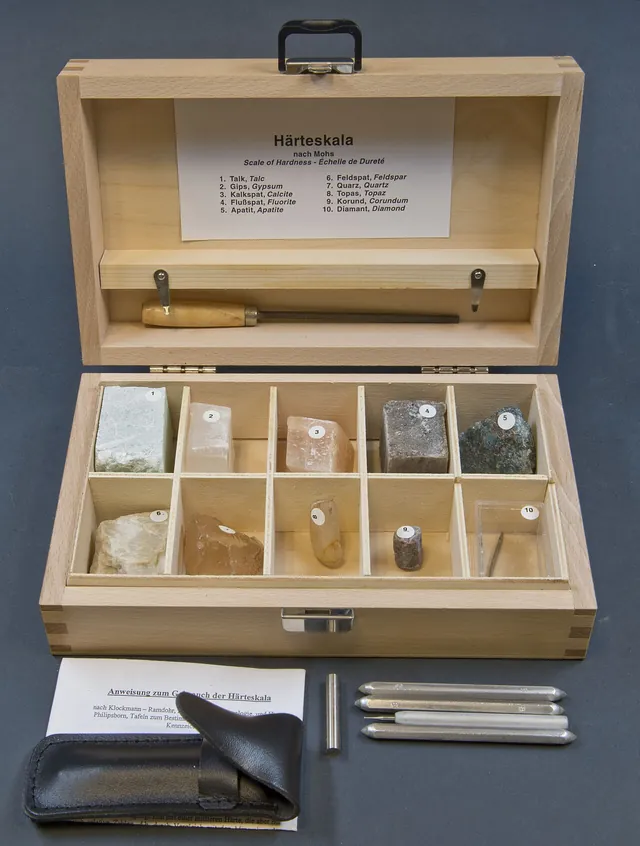
Mohs hardness is a scratch test. A gem scratches anything lower on the scale and is scratched by anything higher. The steps are not even, so corundum at 9 is far harder than topaz at 8, and diamond at 10 is harder again by a wide margin. The Mohs hardness scale page explains why.
Refractive index (RI) measures how much a gem slows and bends light. Gemologists read it on a refractometer, and it is one of the most useful single numbers for telling one gem from another. Doubly refractive gems show two readings, so the chart gives a range. The page on refractive index covers how the reading is taken and why the standard instrument cannot read above about 1.81.
Specific gravity (SG) compares a gem's weight with the weight of the same volume of water. A gem with SG 4.0 weighs four times as much as its own volume of water. Stones with high SG look smaller than lighter stones of the same carat weight, which matters when you compare sizes. The specific gravity page shows how it is measured.
Crystal system describes the symmetry of the atomic structure. It decides whether a gem is singly or doubly refractive and shapes how rough crystals grow. See crystal systems in gemstones for the seven systems.
Using the numbers
No single property identifies a gem. Red spinel and ruby can look alike, but their RI and SG differ, and spinel is singly refractive while ruby is doubly refractive. Gemologists combine several readings with what they see under magnification. The guide on how to identify gemstones walks through that process.
Hardness also tells you how a gem will wear. Household dust contains quartz at 7 on the Mohs scale, so gems below 7 slowly lose their polish in rings worn every day. Hardness is only part of the picture, since toughness and cleavage also decide whether a stone chips or splits. The page on gemstone durability covers all three.
Values here are typical ranges from standard gemological references. Single stones can fall outside them because of trace elements, inclusions or treatments, and organic and rock-like materials such as pearl or lapis lazuli vary more than crystals do.
Frequently asked questions
Which gem is the hardest?
Diamond, at 10 on the Mohs scale. Ruby and sapphire, both corundum, come next at 9.
Which gem has the highest refractive index?
Among the gems in this chart, diamond has one of the highest, about 2.42. Zircon, demantoid garnet and titanite are also high, which is part of why they sparkle.
Why do some gems show a range of values?
Many gems belong to mineral families whose chemistry varies, and doubly refractive gems give two RI readings. The chart shows the range a gemologist would expect.
Can I use this chart to test my own stone?
It helps you know what to look for, but RI and SG readings need a refractometer and a precise balance. A gemologist or lab can take them for you.