Bo Phloi is a district in Kanchanaburi province, western Thailand, and the site of the country's best-known western sapphire field. Alluvial sapphire was found near the town of Bo Phloi in 1918. Output stayed small for decades, then climbed sharply in the late 1980s, and through the 1980s and 1990s the area ranked among the major sapphire sources of Southeast Asia. Its stones are mostly blue sapphire, usually dark, and nearly all of them reach the market after heat treatment.
Where Bo Phloi is
The district lies northwest of Bangkok, in the hilly country that runs toward the Myanmar border. The town of Bo Phloi sits a few tens of kilometers north of Kanchanaburi town; published distances range from about 30 to 45 km depending on the route and the starting point. The district covers just under 1,000 square kilometers, and much of it is farmland today.
The gem gravels lie in a basin that runs roughly north to south. Estimates of the gem-bearing area range from about 70 to 100 square kilometers. Geologists have described it as the largest alluvial sapphire deposit in Southeast Asia.
How the sapphires got there
Bo Phloi belongs to the same family of deposits as the ruby and sapphire fields of Chanthaburi and Trat in eastern Thailand and Pailin in Cambodia. In each case, young alkali basalt lava rose from deep in the earth and carried corundum crystals to the surface. The basalt at Bo Phloi is late Pliocene in age, with radiometric dates of roughly 3 to 4 million years. It still crops out on low hills near the town and a few kilometers to the north. The igneous rocks page covers how basalt forms and why it can carry crystals picked up at depth.
The basalt did not grow the sapphires. Studies of tiny mineral grains trapped inside Bo Phloi sapphire point to an older origin in the lower crust. Most crystals seem to have formed from a silica-poor, alkali-rich melt similar to syenite, and a smaller group formed where hot basaltic magma reacted with surrounding rock. Zircon grains inside some Bo Phloi sapphires have been dated to about 24 million years, so the corundum was already old when the basalt picked it up.
Once the lava cooled and weathered, the hard sapphire crystals were freed and washed into streams. Over the Quaternary period, rivers sorted them into gravel beds on low terraces and floodplains. Miners call these gem-rich layers paystreaks. At Bo Phloi they are buried under several meters of clay and sand, with the richest gravel often found between about 5 and 15 meters down.
Mining history
The 1918 find set off a small gem rush, and the town of Bo Phloi grew up beside the diggings. Thailand had lost the Pailin sapphire field to French Indochina in 1907, so a new source of blue stones drew interest. Early production was modest and uneven. Accounts describe periods of renewed activity around 1929 and again in the late 1970s.
The big change came in the late 1980s. Operators dug large open pits to reach the gem gravel, which was then washed and sorted. Through the late 1980s and early 1990s Bo Phloi was one of the main suppliers of blue sapphire to the cutting and heating trade in Thailand. The work was costly: miners moved huge volumes of earth for each carat of gem rough.
By the mid-1990s the richest gravels had been worked out, and output fell. Mining continued on a much smaller scale into the 2000s. Many old pits have since been turned into fish ponds, lakes, golf courses and plantations.
What Bo Phloi sapphire looks like
Bo Phloi sapphire is mostly blue, from medium blue to very dark, inky blue. Like most corundum from basalt fields, it carries a fair amount of iron. Iron darkens the color and can add a greenish cast, and it also suppresses fluorescence, so these stones usually look inert under ultraviolet light. Color zoning is common, and cutters have to orient the rough carefully to hide bands of uneven color. The gem trade has described the best Bo Phloi color as a deep "twilight" blue, darker than the lighter cornflower blues associated with Sri Lanka.
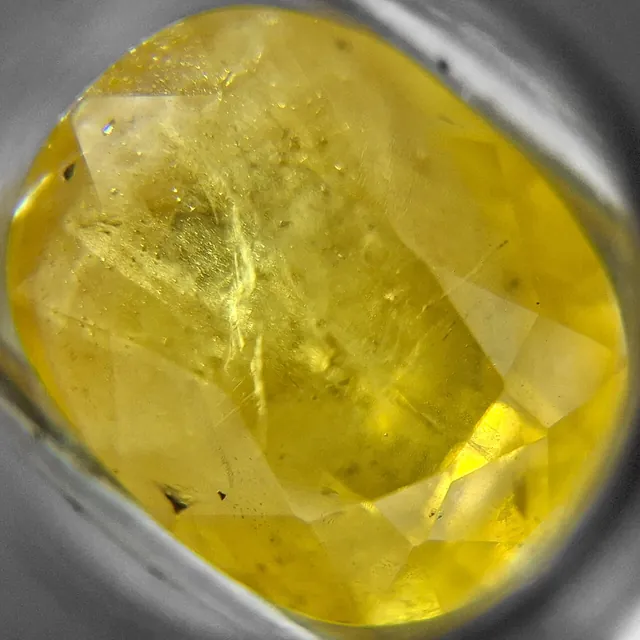
Lab studies have also found brown and yellow sapphire in the gravels, though blue was always the main product. Inside the stones, gemologists have identified alkali feldspar, nepheline, zircon, iron-rich spinel, garnet and other minerals. These inclusions help separate basalt-related sapphire from sapphire that grew in marble or metamorphic rocks.
The refractive index and specific gravity fall in the normal ranges for corundum. Nothing in a standard gem test marks a stone as Bo Phloi. Labs that issue origin opinions usually rely on trace-element chemistry, and even then they often report a broad basalt-related origin because Bo Phloi, Chanthaburi and Pailin stones overlap so closely.
Heat treatment
Most Bo Phloi rough is too dark to sell well as mined. Heating in Thai furnaces, in Chanthaburi and Bangkok, became the standard way to lighten the color and even out zoning. Heated stones are routine in the trade, and unheated Bo Phloi sapphire of fine color is very rare. The page on sapphire treatments explains how heating changes the iron and titanium that cause blue color in corundum, and how labs detect it.
Spinel, zircon and other by-products
Washing plants at Bo Phloi recovered more than sapphire. Large amounts of black spinel, known in Thai markets as "nin," came out of the same gravels, and much of it was sold in Thai markets as a stand-in for onyx. Black spinel, clinopyroxene and feldspar (sanidine and anorthoclase) also occur as large single crystals in the host basalt. Spinel and corundum often turn up together because both form from aluminum-rich rocks.
The gravels also hold garnet and minor zircon. Black star sapphire, another product of Thai basalt fields, is linked mainly with the Chanthaburi area rather than Bo Phloi.
Bo Phloi compared with Chanthaburi and Trat
| Feature | Bo Phloi (west) | Chanthaburi and Trat (east) |
|---|---|---|
| Main product | Blue sapphire | Ruby and sapphire, including black star sapphire |
| Host | Weathered Pliocene alkali basalt | Weathered young alkali basalt |
| Peak era | Late 1980s to mid-1990s | Mid to late 20th century |
| Typical color | Dark blue, often zoned | Dark red ruby, dark blue sapphire |
| Later role | Mining much reduced | Major trading and heating center |
Both fields share iron-rich, dark stones and a long tie to Thai heating. The difference is in what each produced: the eastern fields were famous for ruby, while Bo Phloi was mainly a blue sapphire source. Stones from the two areas are often traded together, and many parcels in Bangkok carry no specific origin.
Buying Bo Phloi sapphire
Stones described as Bo Phloi or Kanchanaburi sapphire on the market today are mostly old production from the 1980s and 1990s. Assume heating unless a lab report from a reputable laboratory says otherwise. For general advice on reports, disclosure and judging color, see how to buy a gemstone. Sapphire from basalt sources can look much like dark material from Sri Lanka after heating, so origin claims are best treated with caution.
Frequently asked questions
When was sapphire discovered at Bo Phloi?
Alluvial sapphire was found near Bo Phloi in Kanchanaburi province in 1918. The field became a major sapphire source in the 1980s and 1990s, with peak output in the late 1980s and early 1990s.
Is Bo Phloi sapphire still mined?
The richest gravels were largely exhausted by the mid-1990s. Mining continued at a much smaller scale for some years, and many former pits have been converted to other uses.
Why is Bo Phloi sapphire so dark?
The stones came up in iron-rich basalt and contain more iron than sapphires from marble or metamorphic rocks. Iron deepens the blue and adds green or gray tones, so heating is used to lighten most of them.
Are Bo Phloi sapphires heated?
Nearly all of them are. Heating in Thailand lightens the color and reduces zoning, and unheated stones of good color are very rare.