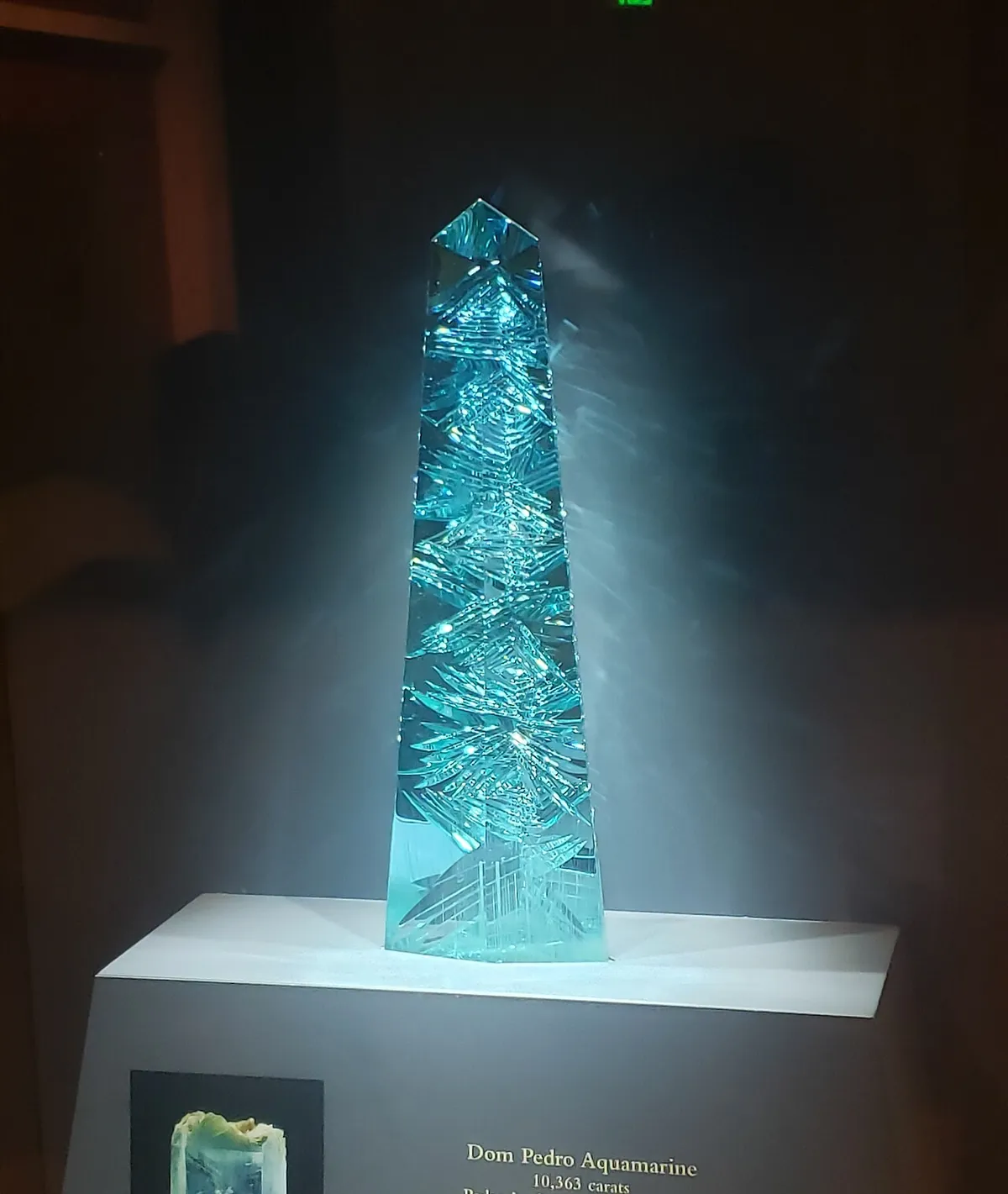
The Dom Pedro is the largest cut aquamarine in the world. It is a blue obelisk about 35.6 centimeters (14 inches) tall that weighs 10,363 carats, a little over 2 kilograms. The German gem artist Bernd Munsteiner carved it from part of a much larger crystal that miners found near Pedra Azul, in Minas Gerais, Brazil, in the late 1980s. Since December 2012 it has been on permanent display at the Smithsonian's National Museum of Natural History in Washington, D.C.
Where the crystal came from
The Smithsonian's catalog record for the gem lists its locality as Pedra Azul, a town in northeastern Minas Gerais. This part of Brazil sits on a belt of granitic pegmatites that has supplied much of the world's aquamarine, along with tourmaline, topaz and other beryl varieties. The Minas Gerais gem region page describes the wider mining area and its markets.
Accounts of the find agree on the size of the original crystal. It was close to 1 meter (nearly 3 feet) long and weighed around 45 kilograms (about 100 pounds), or roughly 225,000 carats. Prospectors dug it out of a pegmatite, and during extraction it fell and broke into three pieces.
The two smaller pieces were sold and cut into faceted stones for jewelry. The largest piece, a six-sided column a little under 60 centimeters (23.25 inches) long and weighing nearly 27 kilograms (about 60 pounds), was kept whole. That fragment became the Dom Pedro.
Why pegmatites grow giant crystals
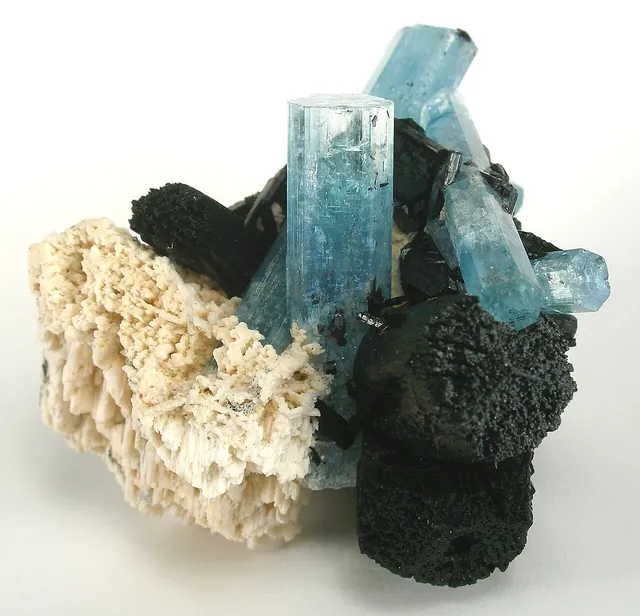
Pegmatites are very coarse-grained igneous rocks that form from the last, fluid-rich portion of a cooling granite magma. That leftover melt collects rare elements such as beryllium, lithium and boron, which ordinary rock-forming minerals do not take in. The water-rich fluid lets atoms move easily, so crystals can grow very large. Open cavities, called pockets, give beryl room to grow as long hexagonal prisms with clean faces.
Aquamarine owes its color to iron. Ferrous iron gives the blue, while ferric iron adds yellow, so many rough crystals look blue-green. The Dom Pedro shows a soft blue with a slight green cast. Beryl rates 7.5 to 8 on the Mohs hardness scale, hard enough to take a sharp polish and keep crisp edges on carved grooves and facets. The gemstone color page explains how trace elements like iron color a mineral.
Munsteiner's design and cutting
A group of gem dealers bought the large fragment and sent it to Idar-Oberstein, Germany, a town that has cut agate and colored stones for centuries. There it went to Bernd Munsteiner, a cutter known since the 1960s for sculptural "fantasy cuts" that mix carving with faceting. The history of Idar-Oberstein covers the town and Munsteiner's place in it.
According to the Smithsonian, Munsteiner spent about four months studying the crystal before he made a cut, then about six months carving, polishing and faceting it. Published accounts say the work was finished by the end of 1992.
He chose a tall, tapered obelisk that kept as much of the crystal's length as possible. On the back faces he cut tapering grooves, often called negative cuts or negative facets. These are concave or notched surfaces cut into the stone instead of standing out from it. Light entering the front reflects off these inner cuts and returns as a pattern of bright stripes and blocks, which changes as the viewer moves. Small hollow tubes, natural flaws in the crystal, run along the base, and Munsteiner left them in place instead of cutting them away.
The finished piece is about 35.6 centimeters tall and about 10 centimeters (4 inches) across at the base. At 10,363 carats it kept less than a tenth of the fragment's starting weight, which is normal for a carving where shape mattered more than yield. The contemporary jewelry designers page puts Munsteiner's style in the context of other studio cutters.
The name
The gem is named after Brazil's first two emperors, Dom Pedro I and his son Dom Pedro II. Pedro I declared Brazil's independence from Portugal in 1822, and Pedro II ruled until the monarchy ended in 1889.
From private hands to the Smithsonian
After it was cut, the Dom Pedro traveled to exhibitions in several cities. In the late 1990s its owners offered it to the Smithsonian for sale, but the museum relies on donations and did not buy it. One of the owners then discussed cutting the obelisk into many smaller gems for the jewelry trade.
The American collectors Jane Mitchell and Jeffery Bland bought it to keep it whole. They held it privately for some years and donated it to the Smithsonian in 2011. The museum put it on public view on December 6, 2012, in the Janet Annenberg Hooker Hall of Geology, Gems, and Minerals, in the same suite of galleries as the Hope Diamond.
How it compares with other aquamarines
Aquamarine is one of the few gems that regularly forms large, clean crystals, so stones of hundreds of carats are not unusual in museum and dealer collections. Even so, no other cut aquamarine on record comes close to the Dom Pedro in size. Pages on rare gemstones and fancy gem cuts cover other unusual stones and styles.
| Stage | Size |
|---|---|
| Original crystal | About 1 m long, about 45 kg |
| Largest fragment | About 59 cm long, about 27 kg |
| Finished obelisk | About 35.6 cm tall, 10,363 ct (about 2.07 kg) |
Aquamarine is also the modern March birthstone, and the Dom Pedro is often pictured in articles about that month.
Frequently asked questions
How big is the Dom Pedro aquamarine?
It is about 35.6 centimeters (14 inches) tall and about 10 centimeters wide at the base. It weighs 10,363 carats, which is a little over 2 kilograms or about 4.6 pounds.
Where was the Dom Pedro found?
It came from a pegmatite near Pedra Azul in Minas Gerais, Brazil, and was mined in the late 1980s. The original crystal weighed about 45 kilograms before it broke into three pieces.
Who cut the Dom Pedro?
Bernd Munsteiner cut it in his studio in Idar-Oberstein, Germany. He studied the crystal for about four months and spent about six more carving and faceting it, finishing in 1992.
Can you see the Dom Pedro in person?
Yes. Jane Mitchell and Jeffery Bland donated it to the Smithsonian in 2011, and it has been on display at the National Museum of Natural History in Washington, D.C., since December 2012.